Luigi Matera
Dipartimento materno infantile e scienze urologiche, Sapienza Università di Roma, Roma, Italia
Claudia Calogero
SOSD Broncopneumologia, AOU Anna Meyer, IRCCS, Firenze, Italia
Key takeaway: an accelerated cohort study of 30,438 people (aged 4-82 years) — pooling 8 European and Australian cohorts — has for the first time derived empirical lung function trajectories across the entire life course. FEV1 and FVC grow non-linearly during childhood: a rapid phase until age 13-16 years, then slower growth until a peak reached at around age 20 in women and 23 in men. After the peak, decline begins immediately with no plateau phase (FEV1 −38 mL/year in men), earlier than previously estimated. The FEV1/FVC ratio decreases throughout life. Persistent asthma advances the peak and lowers adult values; persistent smoking accelerates decline from age 35-40 years.
Why lung function trajectories were still uncertain
Lung function is a key determinant of health throughout the entire life course. Current models hypothesize several phases: slow growth in childhood, rapid acceleration during puberty with a peak around age 20-25 years, a plateau lasting about 20 years in adulthood, and then a decline. This model derives, however, from cross-sectional or longitudinal studies that do not cover the full lifespan, often subject to important biases: heterogeneous cohorts for gestational age, smoking history, presence of asthma, or other crucial determinants of lung function.
Limits of previous studies: cross-sectional, longitudinal, and selection bias
Available studies left three key questions unresolved:
- whether the increase in lung function during childhood and adolescence is linear or not;
- the exact ages at which peak and decline occur;
- whether a plateau phase exists, and how steep the decline with ageing actually is.
Garcia-Aymerich and colleagues hypothesized that an accelerated cohort design — pooling several pre-existing, population-representative cohorts — could resolve these gaps by empirically deriving lung function trajectories from childhood to late adulthood.
Study design: the accelerated cohort of 30,438 participants
Eight European and Australian cohorts: ages 4 to 82
The study pooled eight prospective European and Australian population-based studies, including 30,438 participants aged 4 to 82 years, born between 1901 and 2006. The accelerated cohort design covers the entire lifespan by combining cohorts at different follow-up stages, overcoming the main limitation of traditional longitudinal studies.
Parameters assessed: FEV1, FVC, and FEV1/FVC ratio
FEV1 (Forced Expiratory Volume in 1 second), FVC (Forced Vital Capacity), and their ratio FEV1/FVC were assessed by forced spirometry, following recommendations valid at the time of each study. Only technically valid manoeuvres were included. Asthma diagnosis and smoking status at each visit were collected from validated questionnaires. To identify turning points in the derived trajectories, the Bayesian Estimator of Abrupt Change, Seasonal Change, and Trend (BEAST) model was applied.
When does lung function peak? Results for FEV1 and FVC
Peak at age 20 in women, 23 in men: no plateau phase
In both sexes, FEV1 and FVC grow in two distinct phases:
- a rapid increase until around age 13-16 years (FEV1: +271 mL/year in males, +232 mL/year in females);
- a slower increase until the peak (FEV1: +108 mL/year in males, reaching the peak at age 23; females peak at age 20).
After the peak, decline begins immediately, with no plateau phase: in males, FEV1 falls at approximately −38 mL/year after the peak. This is earlier and more pronounced than what previous studies had estimated, which assumed a plateau of approximately 20 years in adulthood.
The FEV1/FVC ratio decreases throughout life
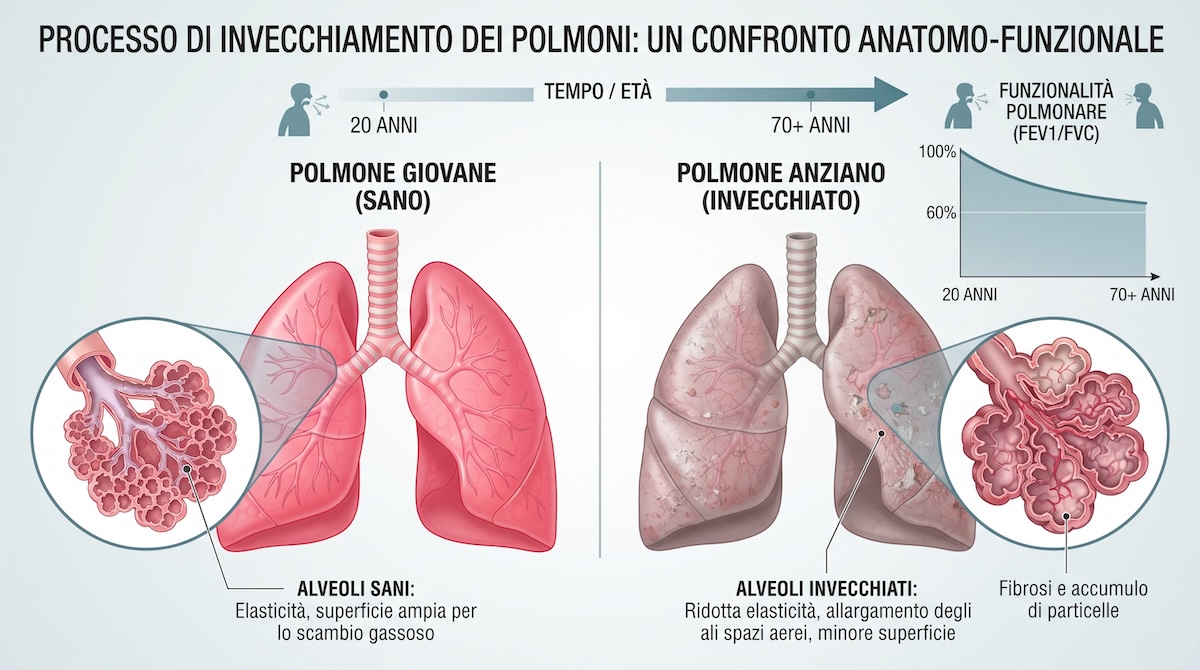
Unlike FEV1 and FVC, the FEV1/FVC ratio decreases continuously throughout life, at rates that vary by age and sex, indicating that the small airways progressively narrow relative to total lung capacity, independently of sex and in the absence of overt disease.
The FEV1 and FVC curves were substantially similar in shape between males and females, with differences in the ages of turning points and in absolute values.
Asthma and smoking: how they alter lung function trajectories
Persistent asthma: earlier peak and lower adult values
Participants with persistent asthma showed, in both sexes, an earlier peak in FEV1 compared with those who never had asthma, with significantly lower FEV1 values throughout adulthood and a markedly lower FEV1/FVC ratio across the life course.
Female participants with persistent asthma also showed an earlier FVC peak compared with women without asthma, and lower adult FVC values. This difference in FVC peak between healthy and asthmatic participants was not observed in male participants.
Persistent smoking: accelerated decline from age 35-40 years
In both sexes, persistent smoking was associated with an accelerated decline in FEV1 and in the FEV1/FVC ratio starting from the 35-40 year age bracket. The signal does not emerge in younger age groups, but consolidates in middle age with progressively greater impact.
Why monitoring spirometry across the life course matters
The study provides, for the first time, a comprehensive empirical framework — previously unavailable — to assess and monitor lung health across the life course. The findings highlight three key clinical implications:
- The lung function peak arrives earlier than expected, and decline begins immediately after, with no plateau: reference models need to be updated.
- Asthma — even without severe exacerbations — permanently alters trajectories: early diagnosis and treatment in childhood have lasting effects on adult respiratory health.
- Smoking accelerates decline from middle age: smoking cessation before age 35-40 can significantly limit lung function loss.
Further studies are needed to evaluate whether tracking individual trajectories — not just single point-in-time values — could improve early detection of COPD and other chronic respiratory diseases.
References
1. Garcia-Aymerich J, de las Heras M, Carsin AE, Accordini S, Agustí A, et al. General population-based lung function trajectories over the life course: an accelerated cohort study. Lancet Respir Med. 2025 Jul;13(7):611-622. doi: 10.1016/S2213-2600(25)00043-8. PMID: 40383131. PMCID: PMC12209707.
2. Agustí A, Faner R. Lung function trajectories in health and disease. Lancet Respir Med. 2019;7:358-364.
3. Burrows B, Lebowitz MD, Camilli AE, Knudson RJ. Longitudinal changes in forced expiratory volume in one second in adults. Am Rev Respir Dis. 1986;133:974-980.
4. Ware JH, Dockery DW, Louis TA, Xu XP, Ferris BG Jr, Speizer FE. Longitudinal and cross-sectional estimates of pulmonary function decline in never-smoking adults. Am J Epidemiol. 1990;132:685-700.
5. Kerstjens HAM, Rijcken B, Schouten JP, Postma DS. Decline of FEV1 by age and smoking status: facts, figures, and fallacies. Thorax. 1997;52:820-827.
6. Schouten JP, Tager IB. Interpretation of longitudinal studies. An overview. Am J Respir Crit Care Med. 1996;154:S278-S284.
7. Quanjer PH, Stanojevic S, Cole TJ, et al. Multi-ethnic reference values for spirometry for the 3-95-yr age range: the global lung function 2012 equations. Eur Respir J. 2012;40:1324-1343.
8. Mannino DM, Watt G, Hole D, et al. The natural history of chronic obstructive pulmonary disease. Eur Respir J. 2006;27:627-643.
Frequently asked questions
At what age does lung function peak?
According to the accelerated cohort study of 30,438 people published in The Lancet Respiratory Medicine in 2025, FEV1 and FVC peak at around age 20 in women and age 23 in men, after a two-phase growth: rapid until age 13-16 years, then slower until the peak.
Does lung function stabilise after the peak or does it decline straight away?
It declines straight away, with no plateau phase. After the peak, FEV1 falls at approximately −38 mL/year in men. This is one of the most important findings of the Garcia-Aymerich et al. study (Lancet 2025): previous models assumed a plateau of about 20 years in adulthood, but the new data on 30,438 people do not support this.
Does asthma affect lung function in the long term?
Yes. Participants with persistent asthma had an earlier peak in FEV1 and significantly lower FEV1 values throughout adulthood, with a markedly lower FEV1/FVC ratio across the life course, compared with those who never had asthma.
At what age does smoking start to damage lung function?
The study shows that persistent smoking is associated with accelerated decline in FEV1 and the FEV1/FVC ratio from the 35-40 year age bracket, in both sexes. The signal consolidates in middle age with progressively greater impact.
Does the FEV1/FVC ratio remain stable throughout life?
No. The FEV1/FVC ratio decreases continuously throughout life, at rates that vary by age and sex, indicating that the small airways progressively narrow relative to total lung capacity, even in the absence of overt disease.
Why is it important to monitor spirometry across the life course?
Because the lung function peak arrives earlier than expected and decline begins immediately after, with no plateau. Monitoring individual trajectories over time — rather than a single value at a single point — could improve early detection of COPD and other chronic respiratory diseases, particularly in patients with asthma or a smoking history.
No metadata found.